The number in the release
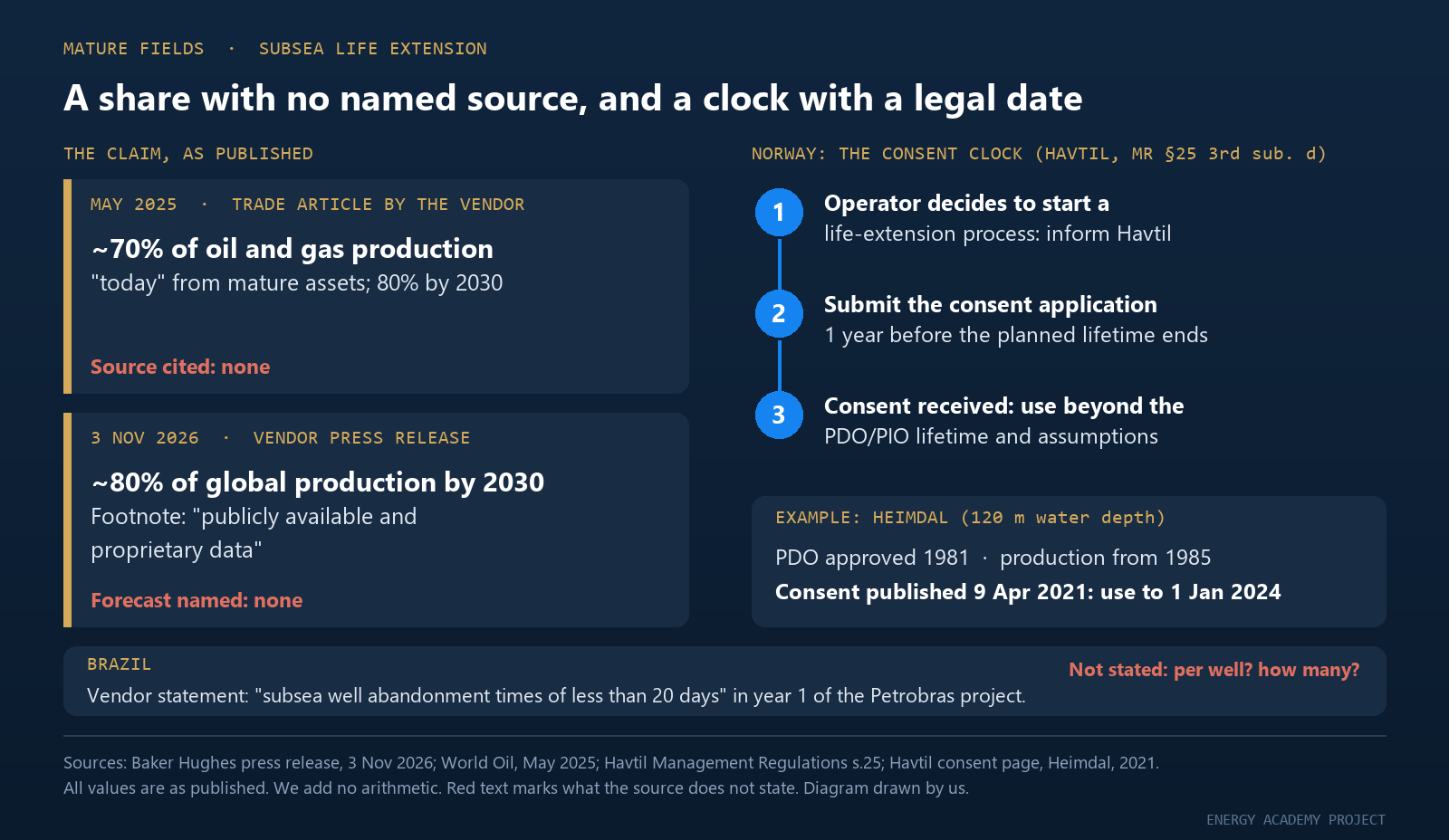
Baker Hughes launched a network of Mature Assets Solutions hubs on 3 November 2026. The venue was ADIPEC, the Abu Dhabi International Petroleum Exhibition and Conference. The release lists six locations: the U.S., Brazil, Norway, Angola, the Middle East and Malaysia. It frames the market with one number. Mature fields, it says, are what "industry forecasts estimate will represent approximately 80% of global oil and gas production by 2030".
Footnote (1) gives the whole basis. It reads: "Industry forecasts include publicly available and proprietary data." The release names no forecast, no author and no definition of "mature". We cannot check the 80%, and we do not use it as a fact. We report it as the vendor's claim.
The same claim, eighteen months earlier
The company used the same frame in World Oil in May 2025. Its Mature Assets Solutions director wrote that "approximately 70% of oil and gas production comes from mature assets" today. He added that the share "is expected to increase to 80% by 2030". That article cites no source for either figure, and it does not define "mature" either.
So the public record holds two statements from one vendor and zero named forecasts. The 80% may be correct. But a number with no study behind it is a sales frame, not a datum. Before you put it in a slide, ask which forecast it comes from and what "mature" means in it. A field past plateau, a field past its design life and a field in decline are three different populations.
What life extension means on a subsea system
The engineering question does not depend on the share. A subsea system has a design life. The design basis fixes it, and the fatigue, corrosion and cathodic protection analyses assume it. Life extension means you show that the system can operate safely beyond that date. You show it with evidence, not with age.
NORSOK U-009, Life extension for subsea systems, covers this assessment in Norway. Its 2023 edition has annexes for trees, structures, valves, manifold piping, umbilicals and control systems. In practice, the work typically covers these checks:
- Fatigue. Reassess risers, jumpers and free spans with the actual load history. Compare the consumed fatigue damage with the design allowance.
- Corrosion and cathodic protection. Assess the remaining wall thickness and estimate the anode depletion. Compare both with the design allowance.
- Barriers and connectors. Use leak tests, operating history and seal qualification data for the items you cannot inspect directly. Our connector post covers why the qualification file matters here.
- Controls and obsolescence. Check that spares, electronics and software support still exist for the remaining years.
- Records. Find the original design, fabrication and qualification data. Without them, every margin becomes an assumption.
The output is a new operating envelope with a new end date. Sometimes it is a decision to stop and plug the wells.
Norway: a consent with a date
Norway makes this a legal step. The rule sits in Section 25 of the Management Regulations, third subsection, litera d. The operator needs consent "before use of offshore and onshore facilities beyond the lifetime and assumptions that form the basis for approval of the PDO, PIO or main application". The PDO is the plan for development and operation. The PIO is the plan for installation and operation.
The same paragraph sets two duties. The operator informs Havtil when it decides to start a life-extension process. Then it submits the application "one year before the planned lifetime expires". The binding Norwegian text on Lovdata says the same: "ett år før den planlagte levetiden utløper". Havtil is the Norwegian Ocean Industry Authority, formerly the Petroleum Safety Authority.
Heimdal shows the mechanism. The PDO dates from 1981, and production started in 1985 in 120 m of water. Production stopped in 2020; the consent covered continued use of the facility. In April 2021 the regulator published its consent to use Heimdal beyond its original planned lifetime. The consent covered the facility "with associated pipelines and wells", until 1 January 2024. Note the scope: pipelines and wells sit inside the same consent as the platform.
For a subsea engineer, the rule has one practical effect. A 2020 letter from the regulator sets the content of the application. It must describe the analyses already done and summarise the technical condition of the facility. In our reading, the life-extension assessment must therefore be essentially complete one year before the planned lifetime ends.
Brazil: abandonment speed without a denominator
In June 2024 Baker Hughes announced a multi-year order from Petrobras. The scope is workover and plug and abandonment (P&A) in pre-salt and post-salt fields. Work was to start in the first half of 2025. That report gives no well count and no duration per well.
The November 2026 release describes "an integrated workover and well abandonment project" with Petrobras. It does not say if this is the 2024 order, but the scope matches. It reports one result: "in the first year of the project, Baker Hughes delivered subsea well abandonment times of less than 20 days". The release does not say whether that is per well, nor how many wells. It does not give water depth, well type or the barrier scope. We therefore cannot compare it with any other campaign. A P&A duration means little without the well design behind it and the count behind the average.
Angola: a hub, and nothing more in the source
Angola appears in the release only as a hub location. The release gives no project, client, field or result for Angola. We found no primary source that adds detail, so we say nothing more.
What we could not confirm
- The 80% and the 70%. Neither source names the forecast or defines "mature".
- The "less than 20 days". We cannot tell if it is a best well, an average or a range, nor the number of wells.
- Angola scope. The source states the location only.
What to watch
- A named forecast. If the vendor or an agency publishes the study behind the 80%, check its definition of "mature".
- Petrobras data. A per-well P&A duration, with well count and water depth, would make the 20 days testable.
- Havtil consents. Each published consent shows which fields reach their PDO lifetime, and when.
- Angola. Watch for a first named project at the hub, with a primary source behind it.